How journalism works, 2017 style

indo-euromillions

Late in the evening of Friday 20 January there came an announcement that the winning ticket in that night’s Euromillions lottery, worth €88.5 million, had been sold in Ireland. Cue the national hysteria which always follows such announcements. ‘Who has the winning ticket?’ ‘Where was it sold?’ ‘What would you do with the money if you won €88.5 million?’ Journalists were dispatched to all corners of the country briefed to find out the answers to these important questions, and virtually every radio programme and TV news bulletin contained an update.
These days, of course, there is another player in the market, ‘social media’, and this fed the rumour mill. Before long, word had spread that the ticket had been sold in Cork, in particular in the village of Glounthane, and even more specifically in Fitzgerald’s shop. ‘Everyone’ knew that this was the case, and even ‘the dogs on the street’ had found out that the winners were a syndicate based in Janssens Pharmaceuticals on a nearby industrial estate.
Cue more hysteria. RTE News had a live feed into the main evening news. The Wednesday morning tabloids ran the story on their front pages and by the afternoon the shop’s owner was telling a chat show that her mother was hoping the publicity might get her a husband.
By Thursday morning, the owner’s potential suitors might have been reconsidering. Nothing more had emerged from Cork and the satellite trucks pulled out of downtown Glounthane. Then came rumours that the ticket might have been sold elsewhere in the country, probably in Dublin.
And so it proved. First thing on Friday morning the National Lottery told RTE’s Morning Ireland that they would be making an announcement as to which province the ticket had been sold in. But when the spokesperson went live on air, he went further than this and announced the actual shop in which it had been sold – the Applegreen service station on the M1 motorway in Lusk, Co Dublin.
More pandemonium. The first ‘National’ edition of Dublin’s ‘evening’ paper, The Herald, had already gone to press.

herald1-img_1259

The front page splash had reported how a Clondalkin shopkeeper had posted on Facebook that he had sold the winning ticket in his branch of Tuthills. The next day, he overheard one woman saying to another: ‘Did you hear the winning ticket was sold in Tuthills? I just thought it was hilarious.’

herald2-img_1261
Within hours, The Herald had replaced its front page for the ‘City Final’ edition. Photographers and film crews had descended on the Applegreen service station where the happy staff posed with glasses of Bucks Fizz for pictures. And there was also plenty of publicity for the service station’s decision to drop the price for fuel to 88.5c per litre until stocks ran out.
But just who were the lucky winner (or winners)? The Lottery was staying quiet on that, other than confirming they had been in touch with them about collecting their prize. Will there be a concerted drive to find out who they are? Or will their obvious desire for privacy be respected? Time will tell. But if there are any rumours, or false posts on Facebook, then you can be sure that the Great Irish Press will be on the case.
Telling it like it is

stratjub

Pic: Diamond Geezer

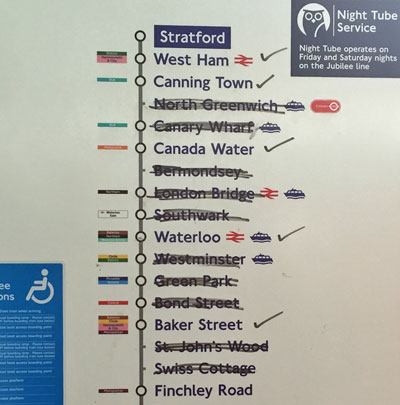
I was in London for most of last week (see my other blog for the reason why). I arrived on Monday morning, halfway through a 24 hour Tube strike. To all intents and purposes it looked as though the whole system was closed down – but in fact this was not so. The incomparable Diamond Geezer spent some of his day travelling round the bits that were open, and wrote it up on Tuesday. Amongst the nuggets he uncovered was this very simple and effective piece of information design. Simple, direct, can be read by anyone in a few seconds. What more can you ask of a piece of information design?

Winston Churchill and the poop of France

9780141019642_16

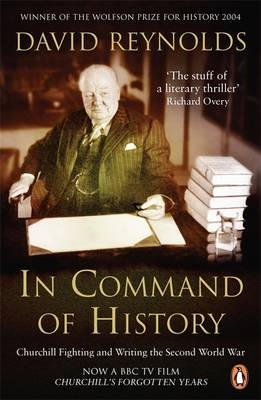
I have been rereading David Reynolds’s masterful account of how Winston Churchill wrote his five volume history, The Second World War. This was an enormous undertaking, for which the great man recruited a research and writing team which included an ex-Cabinet Secretary, the Army general who had been his chief wartime military adviser, another retired general who was on the Advisory Committee for the Official Military Histories, a retired naval commodore, the future Warden of St Anthony’s College, Oxford, and a young barrister and historian who had won the MC in the Far East. This group, nicknamed the Syndicate, were responsible for researching and drafting most of the material which went into the five volumes, published between 1948 and 1953.
I will write more one day soon about Churchill’s writing and production methods, but what caught my eye on this occasion was Reynolds’s account of some of the proofreading howlers which bedevilled the first edition of the first volume, The Gathering Storm. To meet the demands of his American publisher, the book had been first published in New York by Houghton Mifflin in June 1948, but Churchill did not regard this as the definitive edition. He insisted that his London publishers, Cassell, incorporate all the textual errors from the US printing – and more besides – into the UK edition, before final publication in October. Even so, more errors were discovered after many of the sections had been printed and this resulted in two pages of Errata and Corrigenda being incorporated into the book before the Index (unnumbered, but following p.610). Further errors were then identified just before the final binding, so this list was added to by another tipped-in slip which is shown below. The most embarrassing error overall was probably the one which is corrected on this slip, which described the French Army as the ‘poop’ rather than the ‘prop’ of France.

churchill-book2-lores

At this point, Churchill called in the proofreader who had worked on his pre-war biography of Marlborough, Charles Carlyle Wood, He was invited to lunch at Chartwell on 4 October 1948 and given the galley proofs of Volume II, Their Finest Hour.
Wood had in fact offered his services more than a year before, but had been politely rebuffed. He wasn’t really to Churchill’s taste – he had once described him as ‘indefatigable, interminable, intolerable’ – and he certainly didn’t endear himself to Desmond Flower of Cassell’s, who complained that he was altering the sense and wording of some passages and that he had removed 219 commas and added 217. But Wood persisted, and remained on the team for the remainder of the project. He also worked on Churchill’s later books, A History of the English-Speaking Peoples.
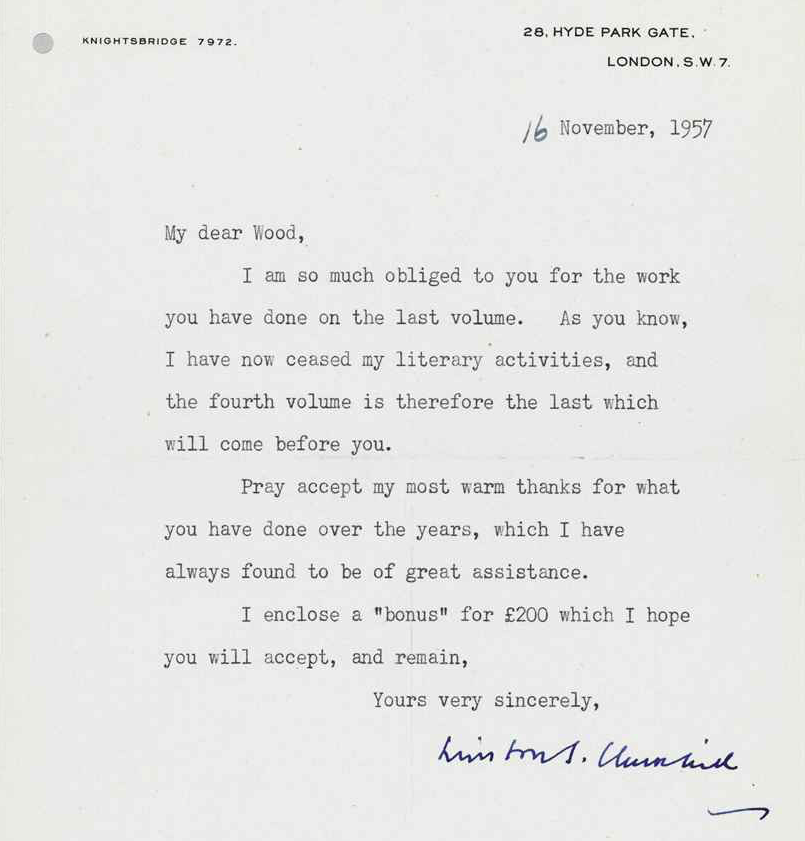
At the conclusion of this series, in 1957, Churchill told Wood that his own writing career had now finished. In a friendly personal letter, seen below, he sent him a ‘bonus’ payment of £200 and thanked him for his efforts over the years.
Wood died in 1959. He is remembered here by his granddaughter on her family history page.

churchill-wood-letter

Pic: Christies

Source: David Reynolds, In Command of History, Penguin 2005.

Sunset and the Equation of Time

park-sunset_1207-edited

Phoenix Park, Dublin. Photograph taken at 1604 on 29 November 2016.

Around this time of the year, I get quite obsessed with the time at which it finally gets too dark to walk my dog. Like many other Dublin dog-owners, I go to the Phoenix Park (a few minutes drive from my house) for her afternoon excursion. It has acres of space in which to walk and often several other dogs with whom mine can run around, so there is much to commend it.
But in order to complete our walk in twilight, we have to start walking about 30 minutes before sunset, which is why timing is crucial. For several years, I have used the wonderful Time and Date website to check when sunset occurs. Amongst the hundreds of useful (and free!) pages included on the site (world telephone dialling codes, for example) is a nifty sunrise/sunset calendar for any location on the planet. I have used this to compile the table below for sunrise and sunset times in Dublin from 15 November 2016 to 7 January 2017:

Sunrise sunset.pages

The most noticeable things in this table are the times I have highlighted in red: the earliest sunset times actually occur between 10 and 15 December, more than a week before the Winter Solstice on 21 December. The 21st may well be the shortest day of the year, but by then sunset has already advanced by two minutes, and the latest sunrise will actually occur eight or nine days later on 29/30 December.
So why does this occur? As you would expect, Timeanddate.com has the answer: it is apparently because of a phenomenon called The Equation of Time as well as a location’s latitude. At the time of both the Winter and Summer Solstices, the length of a solar day (as measured by a sundial) is longer than 24 hours (as measured by a clock).
This explains the discrepancy, and has a pleasant consequence for us dog walkers. By Twelfth Night on 6 January, the sunset time has already advanced by 18 minutes over the earliest time. As they say over here in Ireland, we will be beginning to notice the stretch in the evenings by then.

How book publishing works, the 2016 version

hygge-screen-revised

Cosy socks and log fires: the BBC article which kicked off the Hygge trend

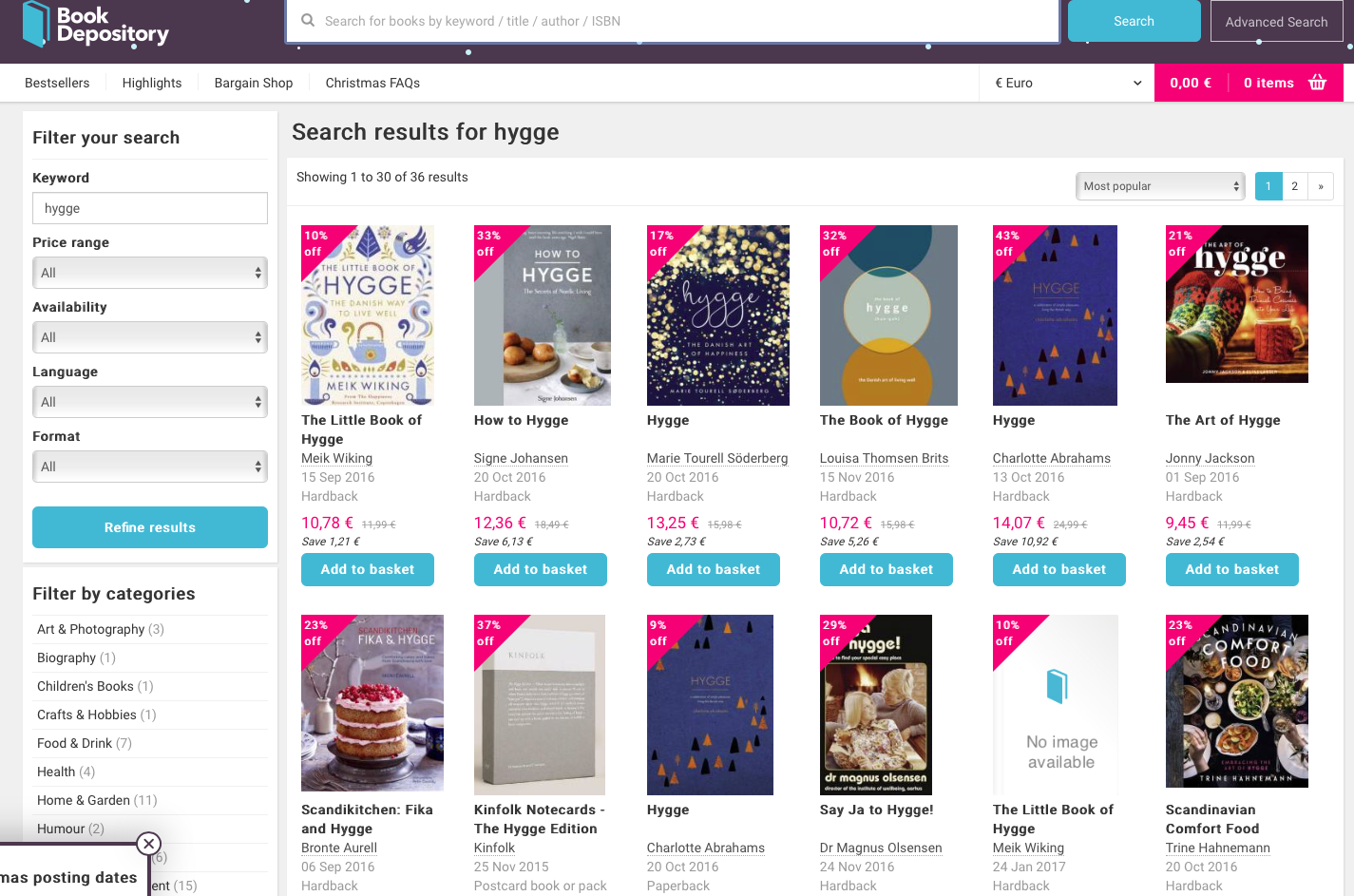
Do any book shopping (either online or in a bricks and mortar shop) in the run up to Christmas and you are bound to come across a host of books with the Danish word ‘hygge’ in the title. The reason for this sudden explosion was explained last week in a fascinating Guardian Long Read piece by its culture editor, Charlotte Higgins.

book-depository-hygge
As Higgins says, every first mention of the word requires helpful hints as to how to pronounce it (I found the most useful to be the Sun‘s suggestion that it rhymes with ‘cougar’). The phenomenon started little more than a year ago, and it was carefully planned:

Hygge has not arrived in our midst by accident. Its sudden presence in Britain is a matter of deliberate inducement and persuasion. In its most visible manifestation – the onslaught of books on the subject – it is a trend that has been carefully concocted in the laboratory of London publishing houses, and then disseminated through the ready collaboration of an enthusiastic neophile press.
It is book editors – largely young, female and bright – who created the formula of hygge for a mass British audience. The starting point for these young lifestyle alchemists was an article that appeared on the BBC website in the first autumnal days of October 2015.

Two of these editors actually worked for different imprints of the same global company, Penguin Random House:

In the sleek art deco headquarters of Penguin Random House, Emily Robertson and Fiona Crosby were working, separately, on potential titles for their respective imprints, Penguin Life and Michael Joseph. Each had also spotted the BBC article, they told me, when we met in a room off one of the building’s echoing marble hallways. “I spend an embarrassing amount of my time flicking around the internet,” said Robertson, “looking at what people are reading and sharing on Twitter. Pinterest is big for this. It’s a case of looking at what people are talking about.”

There have been many instances down the years of publishers picking up popular tastes and creating a market for books on the subject. (A similar plethora of books based on the success of the Country Diary of an Edwardian Lady in 1977 springs to mind as an example from four decades ago.) But what makes this interesting is the commissioning process that Robertson reveals.
After the hours spent ‘flicking round’ websites, she and the other editors had to find writers: but this was ‘not a straightforward exercise’. Higgins writes: ‘the notion of hygge is so taken for granted in Danish language and culture that there was no readymade cohort of authors or experts to call on. The editors had to either track down a willing Dane, or identify someone with tangentially related knowledge.’ So authors ranging from professional writers, political scientists and (inevitably) actors who had appeared in BBC4 drama series were contracted.
The resulting books will now be piled up in your local bookshop ready for the Christmas rush. They will all have covers featuring either warm socks, log fires or home baked buns — or perhaps all three. Most will sell quite well, and one or two may be outright best sellers, because that is the way in which modern publishing works, especially in a post-Brexit, pre-Trump world which is increasingly un-hyggelig.
At the end of her piece, Higgins notes that, however, hygge can have a dark side:

But it is precisely this sense that it is beyond politics – as well as its ubiquitous, irreducible Danishness (and thus not-foreignness) – that allows it to be mobilised by politicians, particularly those of the xenophobic far right, who have become a rising force in Danish politics over the past decade.
A case in point is Pia Kjærsgaard, the founder of the anti-immigration, anti-Brussels Danish People’s Party, which is currently the second-largest party in parliament. Kjærsgaard has subtly projected herself as the protector of Danish hygge against the unknown forces of the globalised world. According to Nors: “Hygge is part of the whole set-up of the radical right wing in Denmark. Their commercials will have all the emblematic hygge symbols.”
Kjærsgaard, who is now the speaker in Denmark’s parliament, gave an interview last year in which she described, in detail, the importance of making her office hyggelig – with family photos, lamps, porcelain and knick-knacks. “I cannot thrive and work in offices that aren’t hyggelig,” she said.

We should reflect on that, perhaps, as with our credit cards in hand, we shuffle towards the harassed shop assistant. In the immortal words of the New Seekers: ‘Let them all fade away and leave us alone/we can live in a world of our own.’

Better deer signs

deer-sign-img_1185-lores

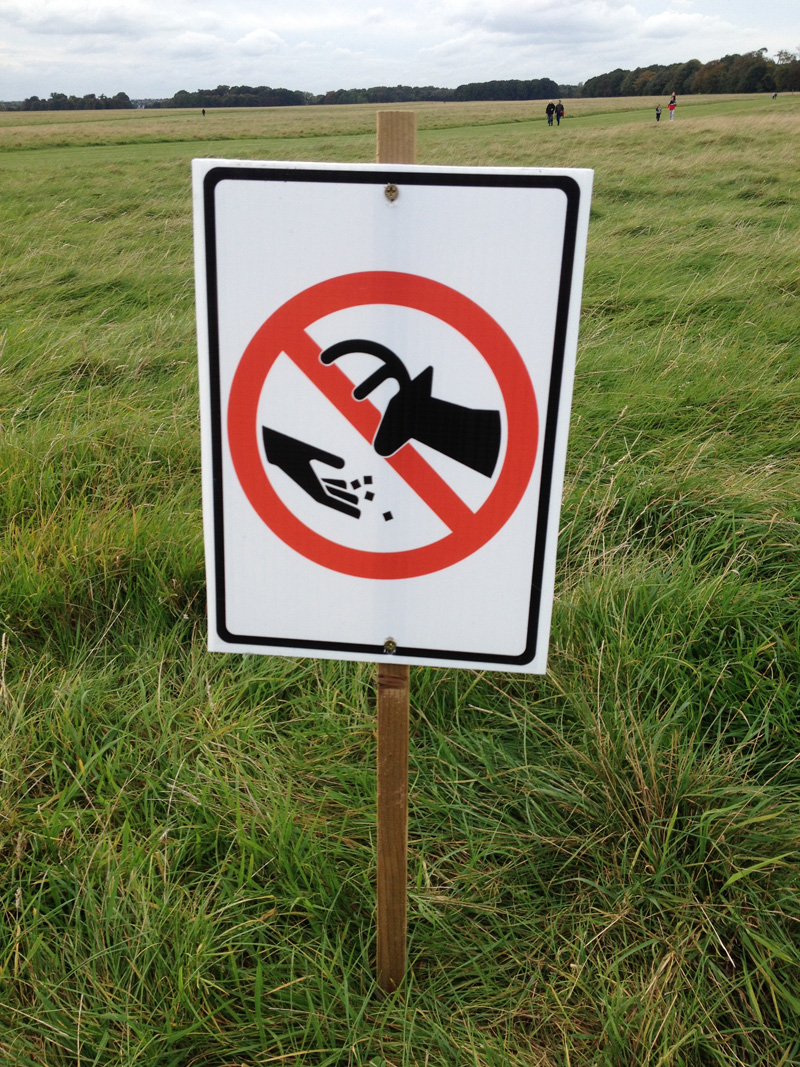
Hot news from Dublin’s Phoenix Park, where the signs warning users not to approach the park’s herd of wild fallow deer have now been replaced by a much more direct “do not feed” notice. The old signs (see below) had been erected in the spring of this year, but had baffled both the park’s staff and its users as to what they meant. The new one, with its use of the internationally recognised red circle and diagonal stripe, is much better designed. It is also nicely drawn, with the deer, the hand and the food reduced to their simplest possible forms.
Whether it will stop the dozens of people who turn up each day with bags of carrots has yet to be seen. I recently found a Tupperware box on the path which was full of carrot pieces, nicely peeled and sliced. Some people obviously have too much time on their hands.

Deer sign1The old sign, now removed.

Smart swash cap for airship design

R100 cover loresR100 inside lores

I have already written about the brochure shown above on my Dambusters blog. However, I thought I would draw attention to it again here, and also write something more about the design and typography.
The brochure (from the Ray Hepner collection) was produced to promote the R100 airship, one of the earlier projects with which the engineer Barnes Wallis was associated. His name of course well known as the person who designed the so-called bouncing bomb during the Second World War, but he had a long career both before and after this period. Back in the 1920s, Wallis headed the design team which built the R100 airship. This was a privately designed and built rigid British airship made as part of the Imperial Airship Scheme, a competition to develop a commercial airship service for use on in the British Empire.
The brochure would seem to have been designed about the time of R100’s first flight. The title page has an interesting design, which involved some hand mortising of metal type. The title itself is set in a large size of Garamond Italic and Roman, with the full point hand cut so that it fits exactly above the tail of the curve of the swash capital R. The rest is set in smaller sizes of Garamond. The upper and lower case in the “Designed and constructed” line was obviously letterspaced in order to drive it out to the same width as the line below. I’m not sure the purists would approve of that.
The cover is completely different: a peculiar sans serif with a short tailed R for the title, and an even odder script for the “Howden Yorkshire” line appear below a rather nice illustration of the airship.
R100 first flew in December 1929. It made a series of trial flights and a successful return crossing of the Atlantic in July–August 1930, but following the crash of its rival, R101, in October 1930 the Imperial Airship Scheme was terminated and it was broken up for scrap. R100, which it could be argued had the more innovative design, was thus terminated even though it had a more successful life.

[Thanks to Ray Hepner]

Every night I sit here by my window

Bobby Darin Things
Every night I sit here by my window (window)
Staring at the lonely avenue (avenue)
Watching lovers holdin’ hands
And laughin’ (ha ha ha)
Thinkin’ ’bout the things we used to do
(Thinkin’ ’bout things)
Like a walk in the park (things)
Like a kiss in the dark (things)
Like a sailboat ride (ya ya)
What about the night we cried
Things like a lover’s vow
Things that we don’t do now
Thinkin’ ’bout the things we used to do

Things by Bobby Darin

Things magazine is a blog which harks back to the original idea of blogging – a concise, erudite guide to material on the interwebnet which the writer has come across, and which he or she thinks might be interesting to other people.
It describes itself as a blog about objects, collections and discoveries. It started as a magazine in 1994 produced by a group of writers and historians based at the Victoria & Albert Museum/Royal College of Art. It then became an independent magazine, separate from these institutions, a biannual home for new writing – essays, reviews, short stories and poems – about objects and their meanings and then evolved in 2001 into a regular blog.
Recent entries have included links to articles about The Classical Organ in Britain 1955-1974, 70s interiors rendered in vivid colour, pictures of abandoned UK railways, a restored modernist gem in Hayling Island, the art, design and story of Kentucky Route Zero and, last but by no means least, the secret, library-based apartments of New York.
The magazine will itself no longer be published in print (sigh), but should continue as a PDF.
Nowadays it often seems that our online spaces have been taken over by the cacophony and illiteracy of social media. Like the Guardian and Radio 4, Things magazine is a corner of the mad, mad world where a calm and witty approach to life still prevails.

Dangling conversations, superficial sighs

geograph-2010523-by-Stephen-Richards

Picture © Copyright Stephen Richards and
licensed for reuse under this Creative Commons Licence.

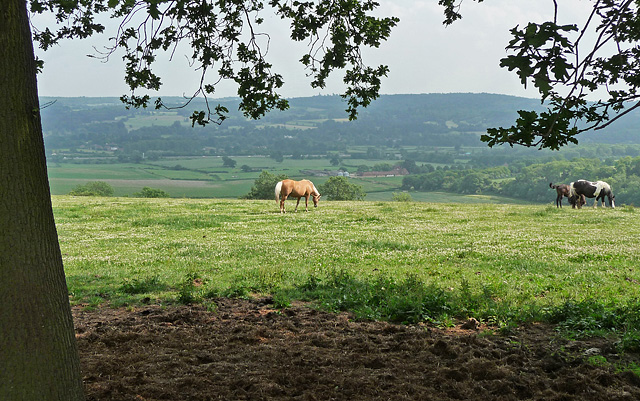
I came across this picture on the Geograph website, having followed a link on a post by the justly-venerated Diamond Geezer about the furthest south-east point in London. Nice picture, but what made me laugh was the great example of a dangling participle in the caption underneath: ‘Having stopped the car to consult a map, this horse appeared to be posing so obligingly that it seemed rude not to take advantage.’

The joy of the footnote

Establishment cover1 loresEstablishment cover2 lores

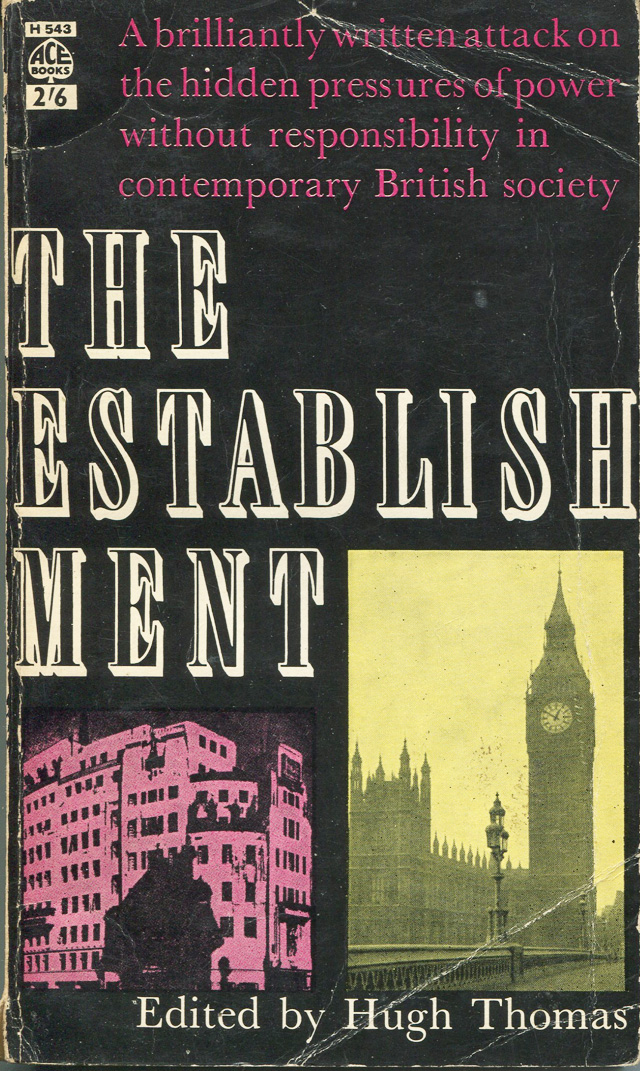
Sorting out some old books a few days ago, I noticed this wonderful back cover on a paperback, The Establishment, published by Ace in 1962. No need for a blurb when you can quote paragraphs from four separate reviews in serious papers. Finest of these is surely that from the TES: ‘… amusing and in places brilliantly written… Dr Balogh’s footnotes are outstanding’.
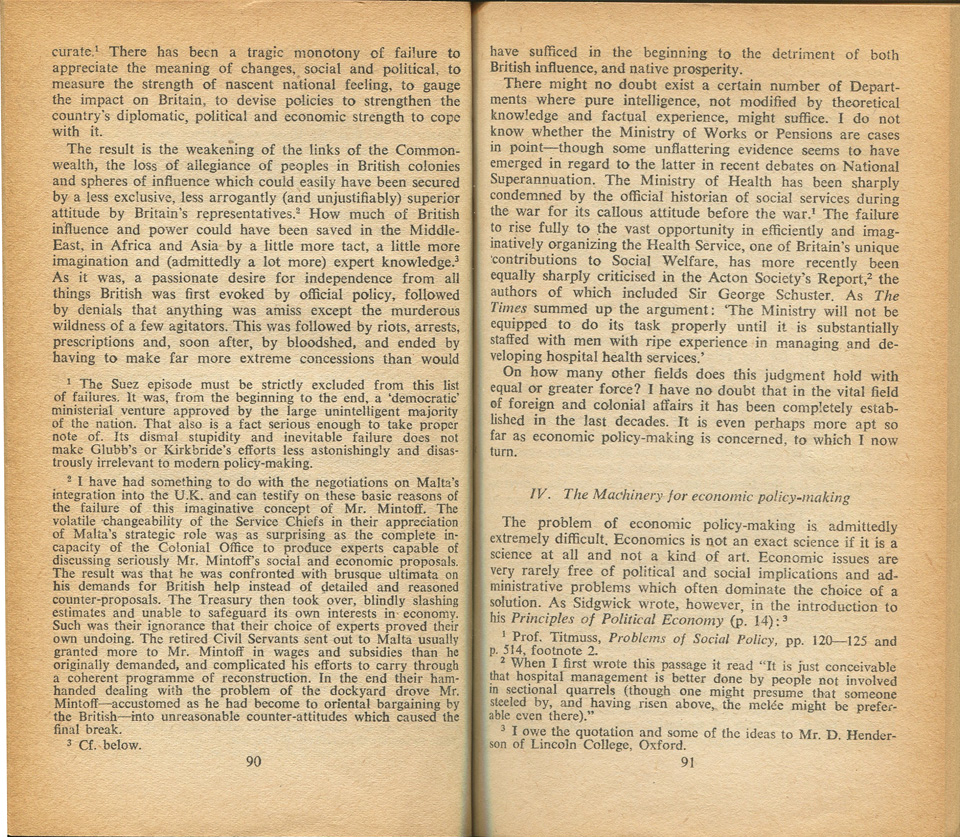
As a devotee of the footnote, I was intrigued to check exactly what was so compelling about Dr Balogh’s piece. It is entitled rather grandly ‘The Apotheosis of the Dilettante: the Establishment of Mandarins’, and is a brief history of the creation and expansion of the UK’s professional civil service. Its footnotes are indeed interesting, many being used for the kind of digressions which have now largely gone out of fashion:

Establishment text loresIn the days of hot metal typesetting footnotes like these must have been a nightmare to sort out. But throughout the chapter, they are very precisely fitted – indeed, on one page the footnote takes up all but seven lines of the text. One might wonder whether the great economist was asked to cut or expand them to fit the pages, although I somehow doubt he would have got involved in such frivolity. In some places, the typesetter’s skill is obvious: on the spread before the one shown above there are two half-line spaces between paragraphs, doubtless inserted in order to bring the first footnote reference on page 90 over to this page.
Nowadays, of course, word processing and page design software do a lot of the work for you. But there is still some skill involved, manipulating the software, cutting or adding a word or two to push a reference forward or back. Here is a page from a local history journal which I designed recently, where each article had copious footnotes.

TOAS Journal loresMaking up pages like this is engrossing work, but very satisfying. I like to use footnotes rather than endnotes in anything I design because they are much the most reader-friendly way of providing references. A glance down the page to check something is a good deal easier (and quicker) than scrolling to the end of the chapter or book. So even if a client has used endnotes in their draft, I tell them I’m happy to change over to footnotes for the final product. Harder work for me, perhaps, but it makes me happy.
As a reader, what makes me very unhappy indeed is when a publisher cuts the footnotes completely from the printed book, telling you that you can go online to find them. A few years ago there was a phase when some firms tried to get away with this (one example can be seen in John Ramsden’s book Don’t Mention the War, published by Abacus in 2006). This mean, penny-pinching attitude and complete disregard for the reader should be countered at all costs.